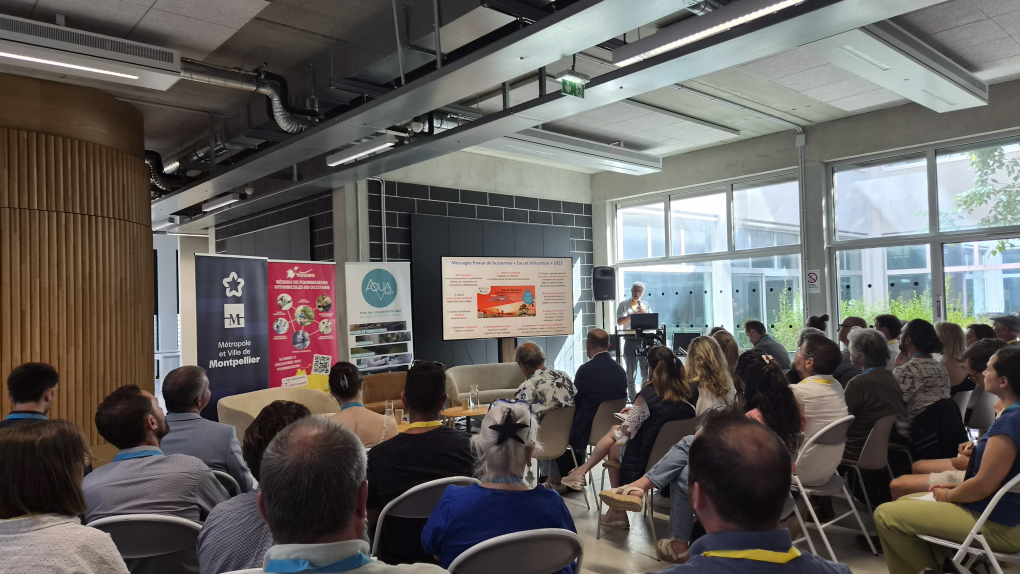
Co-organized by Montpellier Métropole and Vinseo, in partnership with Aqua-Valley and Agri Sud-Ouest Innovation, and with support from the Occitanie Region, this event focused on “streamlining, innovating, and integrating technical, governance, and economic aspects related to water resources.”
The critical challenge of adapting to climate change
With changing markets, environmental constraints, diseases, difficulties in generational renewal, and climate-related pressures, the wine industry is facing multiple crises simultaneously. The consequences can already be seen in declining incomes, reduced profitability, and large-scale vineyard removal programs.
“Vineyard competitiveness is threatened by climate change.”
- Jean-Marc Touzard, economist and research director at INRAE
With temperatures in the Occitanie region already rising by more than 2°C, the outlook is growing increasingly worrying, not to mention declining winter flow rates and tensions between agricultural, urban, and environmental water use. Pressure on water resources is intensifying.
According to the scenarios presented, viticulture can survive if grape varieties, cultivation practices, and water management methods are adapted. Yet irrigation cannot be a one-size-fits-all solution. “It is neither universally applicable nor necessarily a priority,” given the limited availability of water and competing demands.
Access to water, conservation, and innovation: new key factors
“Only 20% of vineyards are currently irrigated, and there are many underserved areas. On average, 37% of vineyards lack access to water.” - Marine Pithon-Guergachi, Occitanie Regional Chamber of Agriculture
Even for those with access to water, the challenge is far from being resolved. Various stakeholders representing the French Institute of Vine and Wine, BRL Exploitation, the Montpellier Water Authority (Régie des Eaux de Montpellier), and the Hérault Chamber of Agriculture talked about yield targets, costs, constraints, and limitations.
Faced with these challenges, a systemic approach to water management is necessary. Future needs require investment, particularly in irrigation control, decision-support tools, network upgrades, and more experimental solutions.
“I irrigate my vineyards with treated wastewater from the treatment plant. It’s already working, but the real problem is acceptance.”
- Jean-Claude Mailhol, winegrower in Murviel-lès-Montpellier
New solutions emerging from a particularly committed ecosystem
Several innovative companies presented their solutions. These included Amoterra, which works on soil restoration using fungi; Geomatys, which is developing a new decision-support tool using satellite data; and Sun’Agri, which employs dynamic agrivoltaics to reduce evapotranspiration, among other benefits.
On the subject of monitoring tools: ITK discussed predictive modeling, while Fruition Sciences uses plants as sensors to monitor sap flow in order to distinguish between water stress and heat stress. Flutilliant provides data through an open-source platform.
Chemdoc offers solutions for water recycling and purification; Ingévin supports the adaptation and optimization of methods to reduce water needs; and lastly, ICV complements process optimizations in the area of hygiene, the first source of water consumption for wineries.
In a Mediterranean region highly exposed to the effects of climate change, the wine industry needs to accelerate its transformation. While the shared assessment is cause for concern, discussions highlighted one key reality: many solutions already exist. From irrigation management and usage optimization to the reuse of treated wastewater, agronomic innovations, and new digital tools, the challenge now is to deploy these solutions on a larger scale and build new economic models.
Thanks to the outstanding coordination noted by participants, and building on the event’s success, additional meetings will be organized soon to support industry stakeholders.